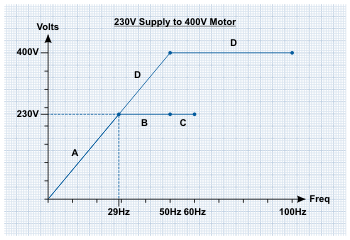
- Curve for 400V Motor with either 240V or 400V Inverter Drive.
- Speed range where Motor Torque progressively reduces.
- Reduced load only is possible.
- Normal Performance Curve for 400V Motor on a 400V Inverter Drive.
It is not uncommon for home workshops to include machinery requiring a 3 phase 400V supply (often marked 380 – 420V). This can appear to be a problem where a 3 phase supply isn’t immediately available. However, it is possible to run such equipment from a domestic 230V supply using nothing more than an off the shelf Inverter Drive.
If you are unable to change the connections or windings to 240V 3 phase, then read on for the next best solution... The speed of an Electric Motor is determined by Voltage and Frequency. So, a 400V 50Hz Motor will run at rated speed at 400V x 50Hz and half rated speed at 200V x 25Hz. Provided this Voltage x Frequency ratio is maintained, the Motor will operate at full Torque – ideal in a Lathe application where speed must remain constant even when a load (the tool) is applied (to a work piece).
An Inverter Drive is not only able to convert a 230V single phase supply to 230V 3 phase but it also controls both the output Frequency and Voltage to maintain the correct ratio. It therefore follows that a 400V x 50Hz Motor will operate normally at 230V x 29Hz, just at two thirds the speed (eg. 1000rpm instead of 1500rpm).
The parameter to set in the Inverter Drive is "Base Frequency", "Motor Frequency" or "Nominal Frequency" (depending on the manufacturer) in Motor Settings. The motor must now be considered as a 230V x 29Hz motor as far as data entry into the Inverter Drive is concerned. The Full Load Current will be that stated on the nameplate for 400V.
If the maximum speed is set to 50Hz or more, the Motor may possibly reach these speeds, but it will become progressively "Under-Fluxed" (Torque will reduce). However, this will only be evident if the Motor is fully loaded. If it is, the Motor will look for more current to meet the load. A correctly set Inverter will provide protection against over-Current by reducing the speed automatically to bring the load current under the maximum set.
It is important to note that when the Inverter output voltage does not match the Motor rated voltage, the drive should match or exceed the Motor full load current (not kW).
Full Load Current of 400V x 50Hz 4 Pole motors are as follows:-
-
5.5kW (7.5HP) - 11.4A
-
4.0kW (5.4HP) - 8.6A
-
3.0kW (4HP) - 6.4A
-
2.2kW (3HP) - 4.9A
-
1.5kW (2HP) - 3.6A
-
1.1kW (1.5HP) - 2.7A
-
0.75kW (1HP) - 2.0A
-
0.55kW (0.75HP) - 1.5A
-
0.37kW (0.5HP) - 1.2A
-
0.25kW (0.33HP) - 0.8A
-
0.18kW (0.25HP) - 0.63A
-
0.12kW (0.16HP) - 0.44A
Three Phase Output Current of 230V Single Phase Input Inverters are as follows:-
- 3.0kW (4HP) - 12.6A
- 2.2kW (3HP) - 9.8A
- 1.5kW (2HP) - 7.5A
- 1.1kW (1.5HP) - 6.7A
- 0.75kW (1HP) - 4.7A
- 0.55kW (0.75HP) - 3A
- 0.37kW (0.5HP) - 2.4A
- 0.25kW (0.33HP) - 1.7A
- 0.18kW (0.25HP) - 0.63A
- 0.12kW (0.16HP) - 0.44A
If the sacrifice of some top speed performance is acceptable for the application, this method provides an excellent low cost solution in allowing domestic workshop use of small Industrial Machine tools.
As is the case with any form of electrical machinery, it is important to ensure that it is installed and commissioned correctly by a competent person and with the proper safety considerations such as earthing and emergency stop provision.